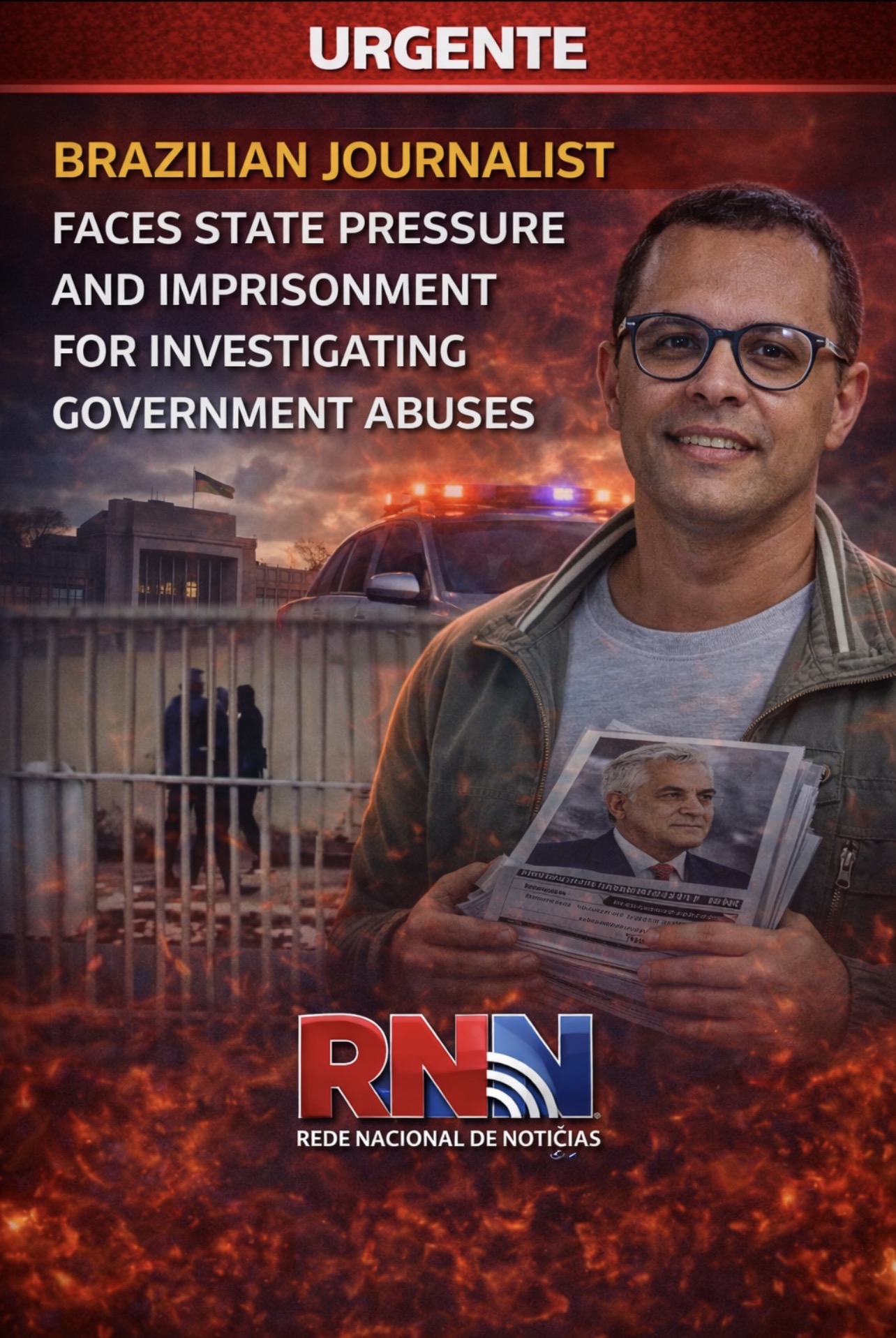
 Goiás State, Brazil — The case of journalist Cristiano Silva, editor of the news outlet Goiás 24 Horas, is raising renewed concerns about press freedom and institutional pressure against investigative journalism at the state level in Brazil.
The situation did not begin with his recent imprisonment.
In March 2020, security camera footage recorded an episode in which Silva was physically assaulted. The incident was formally reported to authorities, and a police report and forensic examination were conducted. The case entered the judicial system. Public reports at the time indicated that individuals allegedly linked to the state’s military security structure were involved. The matter generated significant controversy and public debate.
In subsequent years, Silva became the target of multiple legal proceedings related to his journalistic work, including investigations connected to reports he published about political appointments, alleged power structures, and cases involving law enforcement officers.
Among those proceedings was “Operation Sofisma,” a police operation that targeted journalists and was later archived due to insufficient evidence. Despite the archiving of the case, professional equipment — including mobile phones, computers and notebooks — reportedly remains seized years later, raising questions regarding proportionality and due process.
Most recently, Silva was arrested in connection with a judicial decision related to one of his investigative reports questioning the appointment of a relative of the state governor to a public position.
Each of these events, viewed separately, may fall within formal legal frameworks. However, taken together — recorded aggression, prolonged equipment retention, repeated judicial disputes, archived investigations, and imprisonment — they raise concerns about the cumulative impact on press freedom.
Brazil’s Federal Constitution guarantees freedom of expression and freedom of the press. In ADPF 130, Brazil’s Supreme Federal Court reaffirmed the prohibition of prior censorship. While journalists may be subject to civil or criminal liability under due process, international standards emphasize that legal mechanisms must not be used in ways that produce chilling effects on investigative reporting.
The core issue is not the existence of judicial decisions. It is whether the sequence of actions surrounding a journalist known for investigating power structures and alleged misconduct creates an environment that may discourage critical reporting.
Press freedom organizations are urged to monitor the case closely and assess whether the pattern of events aligns with Brazil’s constitutional commitments and international human rights obligations under instruments such as the American Convention on Human Rights.
When journalists operate under sustained legal and institutional pressure, the implications extend beyond one individual. They affect democratic transparency as a whole.
The situation in Goiás now merits national and international attention.
Nenhum comentário:
Postar um comentário